Wednesday, January 03, 2018

Mueller Under Pressure : He's A democrat So Creditability A Problem

Democrats attack the Constitution because they lost the election?

The bottom line in this investigation will end in October just before the November election.

The result will show, inconclusive evidence, of course, of collusion but will require more investigation into the criminal activity of President Trump.

Mueller will hint that Trump and Republicans are connected to the Russians in some manner but 'we need time and money'. Democrats will proclaim to find the truth, all Republican must be voter out so the Mueller investigation can find resolution.

The truth will take a holiday as it did when democrats are in charge. It's in their DNA. Mueller is no different as his history shows with his connection to Hillary and the sale of Uranium to the Russians as the FBI director. So what's next?

Special Counsel and Russia Probe Seen Likely to Carry On
Fred Lucas / /

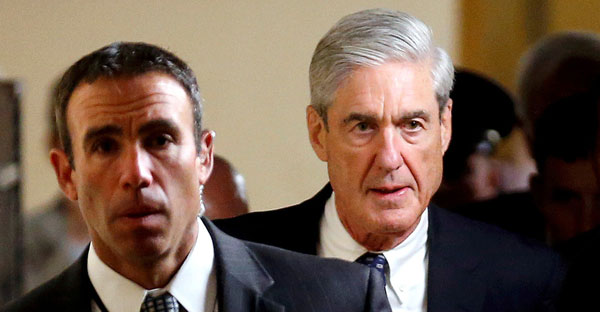
Special counsel Robert Mueller’s investigation of Russian meddling in the 2016 election, and possible collusion with President Donald Trump’s campaign, could fracture in multiple directions during 2018 and take its toll on both men.

For Trump, a prolonged probe could mean a slew of unwelcome headlines, but Mueller still faces withering scrutiny for staffing his investigation with lawyers and FBI agents who demonstrated a political bias.  The special counsel’s investigation into Russian interference in the presidential campaign has been “constitutionally deficient” because of lack of oversight, said Tom Fitton, president of the government watchdog group Judicial Watch.

“The special counsel is operating like the king of the Justice Department. There is no check on him whatsoever,” Fitton told The Daily Signal.  Trump has said he won’t fire Mueller.  But, Fitton said, “Politics aside, Mueller’s investigation has been irredeemably compromised.”

Among the questions raised by those on the special counsel’s team:  —Mueller had to remove an FBI agent, Peter Strzok, from the investigation after electronic text messages emerged showing Strzok calling in 2016 for an “insurance policy” in case Trump were elected.

Strzok led the probe of Hillary Clinton’s use of a private email server to conduct official business as secretary of state. The agent recommended that then-FBI Director James Comey change his statement about Clinton’s habitual use of the server from the legally weighted “grossly negligent” to the more broad “extremely careless” in describing her conduct. Trump fired Comey in May.

—Justice Department lawyer Andrew Weissmann, before joining the Mueller team probing the Russia matter, praised former acting Attorney General Sally Yates for defying a Trump order to enforce his restrictions on travel from terrorism-prone countries. Weissmann remains on the team.

—Nine of the 15 publicly identified lawyers on the Mueller team are Democrat donors, giving a total of $62,043 to Democrat candidates (compared with other team lawyers giving $2,750 to Republican candidates). Of these, three gave a total of $18,100 to Clinton’s 2008 and 2016 presidential campaigns.

—One lawyer on the Mueller team, Jeannie Rhee, defended the Clinton Foundation charity and also represented Hillary Clinton in the email case. Another, Aaron Zebley, represented a Clinton aide who managed the email server.

—Judicial Watch recently filed a lawsuit under the Freedom of Information Act to find out whether Mueller communicated with his fellow former FBI director, Comey, before his Senate testimony in June following a report the two had “closely coordinated” on the testimony. Comey admitted during that testimony that he leaked information in hopes of spurring appointment of a special counsel.

“Mueller’s goal is the prosecution of the president of the United States,” Fitton told The Daily Signal. “If he can’t get President Trump, he wants to get his family, and if he can’t get his family, he wants to get his aides.”

Scorecard

The probe has produced some results so far.  Mueller’s team secured indictments against Paul Manafort, Trump’s campaign manager for several months, and Manafort associate Rick Gates on money laundering and other charges. Both men pleaded not guilty.

Mueller also reached plea deals with Michael Flynn, a former Trump campaign aide who resigned after only weeks as national security adviser, and with George Papadopoulos, a low-level foreign policy adviser on the Trump campaign. Both admitted to lying to investigators.

Much of the criticism of Mueller seems political, said Scott Amey, general counsel for the Project on Government Oversight, one of the watchdog groups that supports a new law to protect Mueller and future special counsels.

“A lot of Republicans stood behind special counsel Mueller’s investigation when he was named,” Amey told The Daily Signal. “Now that the investigation is going on and some of the counts are against people formerly associated with the Trump campaign or administration, they are afraid it will affect the administration and maybe trickle down to them during the midterms.”

Amey said he believes Mueller’s team should be subject to oversight just as any government entity is. But, he said, the removal of Strzok, the FBI agent, shows the team has addressed staffing controversies.

“There are certainly questions that could be raised about the scope of Mueller’s work and his prosecutorial team,” Amey said. “That can be resolved through proper oversight by the Justice Department and from Congress to ensure it stays on course.”  Mueller spokesman Peter Carr declined to comment for this report.

‘No Upside’

During Dec. 13 testimony before the House Judiciary Committee, Deputy Attorney General Rod Rosenstein, who appointed Mueller, told lawmakers he saw no good cause to fire him. “I’m not aware of any impropriety, I’m not aware of any violation of rules,” Rosenstein said at one point.
None of the charges so far have produced evidence to back up Democrats’ allegations of collusion between the Trump campaign and Russians.

The Washington Post reported last month that the special counsel’s probe could last another year. Trump already has said multiple times that he has no plans to fire Mueller, and told The New York Times in an interview last week that he expects the special counsel will treat him fairly.

The president likely won’t sack Mueller given his experience after his firing of Comey, which led to the special counsel probe, said Andrew McCarthy, a former assistant U.S. attorney for the Southern District of New York and frequent legal commentator.  “There is no upside for firing Mueller. He has not laid a glove on Trump. Everytime Mueller does something, Trump says, ‘See, nothing about collusion,’” McCarthy told The Daily Signal, adding:

The investigation has made it harder for Trump to govern and it has pissed him off. But his biggest problem came when he fired Comey, which led to the Mueller investigation. Firing Mueller would be like firing Comey times three.

Still, four government watchdog groups—Issue One, Open the Government, Project on Government Oversight, and the Sunlight Foundation—last month signed a letter urging Congress to support a bill called the Special Counsel Integrity Act that would make it more difficult to fire a special counsel.

Obstruction Case?

The move comes as Republicans in Congress continue to criticize Mueller. “I believe he is a person of integrity, even if he has made obvious mistakes with staffing. He doesn’t seem to be reaching for the stars without evidence,” said McCarthy, who has been critical of the special counsel’s Russia probe. He added:  Staff alone doesn’t discredit the investigation. He has guilty pleas. He needs to get control of staff. If someone appears to have a political ax to grind, fire them. He’s got 17 lawyers, and he doesn’t need 17.

The charges thus far seem to show Mueller wants to build a case of obstruction of justice, possibly around other administration or campaign officials, McCarthy said. “If the case is collusion, which would be conspiracy to commit espionage, he wouldn’t be indicting people for lying to the FBI,” McCarthy said. “If you’re trying to build a case, you don’t use as your witnesses convicted liars.”

Others see a much stronger case against the integrity of Mueller’s probe.  “As more time passes, the more Mueller’s credibility is reduced,” Peter Flaherty, president of the National Legal and Policy Center, a government watchdog group, told The Daily Signal. “The legal case to fire or relieve Mueller is strong. The question is the optics. It might be best to leave him there, since ultimately he will come up with little.”

Flaherty said he believes the Russia investigation is in place to shield the FBI from exposure in using the discredited “Steele dossier,” an anti-Trump document funded by the Clinton campaign, the Democratic National Committee, and the opposition research firm Fusion GPS, to justify the probe of Trump associates.  “Mueller can rescue his credibility by expanding the investigation to Clinton and the genesis of the dossier,” Flaherty said, adding:

The problem with that is that the FBI was involved. The Mueller investigation from the beginning was never to find Russian interference in the election. It always was and continues to be a rear-guard move by former and current FBI officials.

Feeding the Beast

Some Republicans in Congress have called for a second special counsel to look into the roots of the so-called dossier and if it is the basis for the Trump-Russia allegations. But Flaherty said a new investigator isn’t needed, and that Mueller should be able to handle the matter.  “It involves Russian interference in the election,” Flaherty said. “It wouldn’t require an expanded mandate, because it’s clearly in the realm of election influence.”

Recent news reports suggest it actually was boasting to an Australian diplomat by Papadopoulos, the low-level Trump campaign adviser, about the content of Clinton emails that led to the FBI investigation.  Fitton, of Judicial Watch, said he doesn’t buy this idea because it is the product of government leaks.  “It’s another leak of classified information and an attempt to steer attention away from the dossier story,” Fitton said.

McCarthy, the former federal prosecutor from New York, also wrote a recent National Review piece that cast skepticism on what seems to be an evolving narrative about Russian collusion.

The endgame for the special counsel is whether there is an impeachable offense, McCarthy told The Daily Signal. “I have to think Mueller is experienced enough to know he can’t indict a president, so that leaves impeachment,” McCarthy said. “I’m not saying Mueller wants an impeachment. He might see his job as gathering information and leaving it to Congress to decide what to do with it.”

It is almost 20 years since a report by independent counsel Kenneth Starr led to the impeachment of President Bill Clinton in the House of Representatives in December 1998 on charges of perjury and obstruction of justice. The Senate ultimately acquitted Clinton, who had high public approval numbers, and Starr and Republican lawmakers, besieged by criticism, lost the public relations battle.

Controversies aside, Mueller’s prosecutorial background means he likely will avoid Starr’s PR problems, McCarthy predicts.  “Ken Starr was a brilliant legal mind, but he wasn’t a prosecutor. He was an appellate lawyer. Mueller knows how to feed the beast in terms of the media, getting charges out there,” McCarthy said. “Starr went underground for eight months, gathering evidence and preparing a report while the Democrats attacked his case. Mueller has brought three sets of charges. There will be trial dates, discovery, and a continuous flow of news.”

Fitton noted another fundamental distinction between Starr and Mueller.  “The difference is that Starr was investigating actual crimes. Mueller was tasked with investigating Donald Trump and finding a crime,” he said.

Progressives Still Lost In Denial : Socialist Liberalism Failed to Fool The Voters

Just Pondering The Cosmos

Now that the progressive socialist liberal democrats are energized after the win in Virginia and Alabama, but seem to have a selective memory about the other 5 elections that they lost over the last sever months. But never mind, the socialist believe the tide has turned for them revealing a future  smashing victory in November getting the house and maybe even the Senate back in the hands of socialist liberals.

But wait, why would anyone vote to bring back the last 8 years of chaos, conflict and abject failure when Barack and the socialist liberals were in power? Where's the logic in that?

What is surprising to me but maybe shouldn't be, that the progressive democrats continue to trot out the narrative of a 'double digit'' lead in the poles for next November midterm election. But how can anyone believe the poles after the disaster they were last November? They forecast a 93 percentile chance for Hillary to win the election, a landslide victory, and it wasn't just one pole but nearly all had forecast with poling results a rout of Donald Trump and the Republicans.

As the title of Hillary book so apply states, 'What Happened?' or so, the poles were not legitimate in their efforts and therefore biased in favor of an outcome that was never actually found. In fact the progressive democrats were so wholly imbedded with the notion of Hillary winning, facts were never considered. The democrats were actually mentally out of control of their emotions and rational thought.

Little wonder when the actual result came in showing Hillary was defeated, soundly, the shock was so quick and great that the mind of the progressive socialist liberals were unable to cope with the reality that they lost, leaving them clinically mentally crippled, in able to function in the real world.

As we now can witness, on a daily basis on the lettered television channels, cable news and print media, the narrative is so unbalanced and unhinged that the average person's mind cannot comprehend their delusional ravings. They make no sense. The insane are incomprehensible.

But then, why would anyone, that has to live in the real world, understand pathological neurotic behavior, especially when it is presented to the country and the world as normal?

Tuesday, January 02, 2018

Court Rules Aganist Oregon Bakers : Gay Rights Win - Religious Rights Lose - Surprised?

But never forget where this all is taking place, the great state of Oregon, a state that's totally infested with progressive socialist liberals that find tolerance is not a two way street. For justice in Oregon to work, all partiers must believe that progressivism and liberalism is a way of life or you must be driven from the grater civil society and destroyed.

And speaking of rights, what happened to the rights of the bakers? Freedom of religion is no longer a viable part of the Constitution? Why is it that the rights of the gay couple out way the rights of the bakers? Surprised?

Appeals Court Rules Bakers Must Pay $135,000 for Not Making Wedding Cake
Rachel del Guidice / /

A husband-and-wife baking team must pay a $135,000 fine for declining to make a cake for the wedding of two women, Oregon’s second-highest court has ruled.

A three-judge panel of the Oregon Court of Appeals on Thursday upheld a decision by a state agency that led to the fine and forced Aaron and Melissa Klein to close their bakery. The court ruled that baking wedding cakes is not “speech, art, or other expression” protected by the First Amendment. The judges said the state did not “impermissibly burden the Kleins’ right to the free exercise of religion” because it compelled the Christian bakers only to comply with “a neutral law of general applicability.”

Oregon law prohibits businesses from refusing service because of a customer’s sexual orientation, as well as because of race, gender, and other personal characteristics.

“We are very disappointed in the court’s decision,” Michael Berry, deputy general counsel at First Liberty Institute, which represents the Kleins, told The Daily Signal in a phone interview Friday. “I think that punishing people for their religious beliefs is … not American, and it’s wrong.”

“It does not matter how you were born or who you love,” one of the lesbians, Laurel Bowman-Cryer, said in a written statement following the ruling. “All of us are equal under the law and should be treated equally. Oregon will not allow a ‘Straight Couples Only’ sign to be hung in bakeries or other stores.”

Boyden Gray, former White House counsel to President George H.W. Bush, argued the Kleins’ case. Gray told the three judges that the state violated the two bakers’ rights to free speech, religious freedom, and due process. The Kleins had owned and operated Sweet Cakes by Melissa, a bakery in Gresham, Oregon.

 Bakers Accused of Hate Get Emotional Day in Court

After the Kleins declined in 2013 to make a cake for the wedding of Rachel and Laurel Bowman-Cryer, citing their Christian religious beliefs that marriage is the union of a man and a woman, they also faced protests that eventually led them to shut down their bakery.

Watch the video : https://youtu.be/BRo9suMkECQ

In July 2015, an administrative judge for the Oregon Bureau of Labor and Industries ruled that the Kleins violated state law by discriminating against the Bowman-Cryers on the basis of their sexual orientation. The judge ordered the Kleins to pay the $135,000 for physical, emotional, and mental damages to the two women, as The Daily Signal previously reported.

Brad Avakian, Oregon’s elected labor commissioner, had affirmed the heavy damages against the Kleins, The Oregonian reported.

Berry, the First Liberty attorney, said his legal team is deciding how they will move forward, which could mean appealing to the Oregon Supreme Court. “We’re evaluating our options at this point, obviously in terms of whether we are going to appeal, etc., and we’ll discuss all those options with Aaron and Melissa Klein and decide on the best course of action for them,” Berry said.

In a written statement, Kelly Shackelford, president and CEO of First Liberty Institute, a nonprofit legal organization dedicated to protecting religious liberty, said the Kleins are being denied free speech. “Freedom of expression for ourselves should require freedom of expression for others,” Shackelford said. “In a diverse and pluralistic society, people of good will should be able to peacefully coexist with different beliefs. We are disappointed that the court ruled against the Kleins.”

Berry said the Kleins’ situation is an abuse of their religious freedom.

“I think it’s a sad day for our Constitution and for the rule of law in this country when a family-owned bakery can be put out of business simply for trying to follow their religious beliefs,” he said.

Protests In Iran : Trump Must Stand With Freedom


One thing we don't need now is another leader of America that is more concerned with 'leading from behind' and his own personal religious jihad to force entire countries to do his will as he sides with tyrants and mass killers in that effort. 

Barack understood he had and agenda and ideology that needed a weak response to the Iranian million man protest in 2009 or his grand  plan for middle east domination by Iran would fail. If it meant that hundreds would die, even thousands, so what. For Barack, it is and always has been about the grand scheme of his dream of a world religious revolution and with him as the all powerful leader. 

What the US Should Do as Protests Escalate in Iran Against the Islamist Regime
James Phillips /

Iran has been rocked by a wave of protests against the Islamist regime since Dec. 28. Popular demonstrations ignited by smoldering resentment about Iran’s mismanaged economy quickly escalated to political denunciations of Tehran’s rulers. President Donald Trump was quick to offer support to the protesters in a series of tweets. At 7:44 a.m. New Year’s Day, he tweeted:

Iran is failing at every level despite the terrible deal made with them by the Obama Administration. The great Iranian people have been repressed for many years. They are hungry for food & for freedom. Along with human rights, the wealth of Iran is being looted. TIME FOR CHANGE!

Early chants about price hikes have given way to increasingly bold criticisms of what the protesters see as a corrupt and repressive government that fails to meet their needs. Their demands varied.
Some chanted, “We don’t want an Islamic Republic” and “Death to the dictator,” the latter being a reference to supreme leader Ayatollah Ali Khamenei.

Economic Resentments Amplify Political Revulsion

The protests apparently were triggered by a surge in prices of basic food supplies, which also had contributed to early Arab Spring protests six years ago. Protests spread quickly, sparked by social-media posts, as state-controlled media blocked press coverage.

These are the largest protests since millions of Iranians flooded the streets in 2009 to protest against then-President Mahmoud Ahmadinejad’s rigged re-election. But the regime crushed those protests in a brutal crackdown in which at least 30 people were killed and thousands were arrested, tortured, and imprisoned.

So far, the ongoing protests have not reached the size of the 2009 Green Movement demonstrations, when millions of Iranians took to the streets in protest. Twelve people have been killed in demonstrations, with 10 of the deaths inflicted amid intensifying clashes on Sunday night. Some of the early protests in Mashhad reportedly were organized by ultra-hard-line regime supporters opposed to Rouhani, and may have been designed to undermine his authority.

Pro-regime demonstrations denouncing the 2009 Green Movement leaders also may have provoked a political backlash.

Unemployment remains high at more than 12 percent, and inflation has resurged to 10 percent. A recent increase in egg and poultry prices by as much as 40 percent, which a government spokesman blamed on a cull over avian-flu fears, appears to have been the spark for the economic protests.

Hundreds of students and others joined a new economic protest at Tehran University, a hotbed of prior student protests against the regime. Iranian students historically have played a leading role in several revolutionary movements, including the 1979 Islamic Revolution. The tense situation at Tehran University will be a litmus test for the strength of the protest movement and of the regime’s ability to contain, suffocate, or crush the protests.

The Revolutionary Guards, which crushed protests in 2009 and take the lead in exporting Iran’s Islamic revolution and terrorism, remain a strong repressive force that is likely to crush the student rebellion if the local police prove to be inadequate.

Trump’s Rapid Response ;

''Many reports of peaceful protests by Iranian citizens fed up with regime’s corruption & its squandering of the nation’s wealth to fund terrorism abroad. Iranian govt should respect their people’s rights, including right to express themselves. The world is watching!


Trump is right that simmering resentment over the costs of Iran’s aggressive foreign policy have led protesters to call for more spending at home and less on support of radical groups abroad. Some of the new protests have specifically denounced the regime’s extensive corruption and its costly involvement in regional conflicts, such as those in Syria and Iraq.

In Mashhad, some chanted, “Not Gaza, not Lebanon, my life for Iran,” a reference to what protesters say is the regime’s focus on exporting the revolution, rather than responding to domestic needs. They also denounced Iran’s theocratic leaders: “The people are begging; the clerics act like God.”

Washington must continue to drive up the long-term political, economic, and military costs of Iran’s military interventions in Syria, Iraq, and Yemen. It should underscore that the regime’s economic mismanagement, corruption, and support for terrorism and Islamic revolution, which provoked sanctions, have exacerbated Iran’s economic problems.

U.S. policy should also highlight and denounce the regime’s repression and human rights abuses. But the protests might soon be quelled, dissolve into competing camps led by rival leaders, or be hijacked by hostile anti-Western forces, as many of the Arab Spring revolts were hijacked.

Washington should support the right of Iranians to challenge the heavy-handed repression and corruption of a tyrannical regime, but it should hold off on endorsing specific opposition leaders or movements until their character and goals are assessed.

Until then, the Trump administration should do its best to publicize and promote the legitimate political and economic grievances of frustrated Iranians and support their efforts to recover freedom from an Islamist dictatorship that depends on thugs to suppress its own people.


A History of Fake News In America And The World : Deception And Misinformation

This is a little long but a great read. Very interesting and informative on just how the freedom of speech and the press has been an integral part of our history.

If you have to look to one instance where the proof of fake news didn't work in determining the outcome one of the most important election in our history, it was the election of Donald Trump.

The electorate wasn't fooled. The people understood and reacted. They filtered out the misinformation and our right lies by nearly an entire news media, news papers, television channels and cable outlets that was focused on those lies and deception to elect their candidate. 

Thank God for FOX news, talk radio and Rush Limbaugh that countered the deception with the truth. The system does work.

The History of Fake News in the United States
Jarrett Stepman / /

Fake news isn’t suddenly ruining America, but putting government in charge of deciding what news is fake will. In the wake of President Donald Trump’s victory in the 2016 election, numerous media outlets ran stories claiming that many websites had published false stories that helped Trump beat Hillary Clinton.

Since then Left-leaning opinion writers have called for a solution to this alleged epidemic. The New York Times reported last January that Silicon Valley giants Facebook and Google will team up with legacy media outlets to fact-check stories and curtail the proliferation of “fake news.”

However, intentionally misleading news has been around since before the invention of the printing press. In fact, our Founding Fathers grappled with this very issue when they created our system of government. They saw that while it was tempting to censor fake stories, ultimately the truth was more likely to be abused by an all-powerful government arbiter than the filter of unimpeded popular debate. Attempts to weed out factually incorrect news reports can quickly morph into fact-checking and manipulating differences in opinion.

Fortunately, there have been few serious calls in the United States for official censoring of political news or media, in contrast to most of the world, including Europe. Freedom of thought, freedom of the press, and even the freedom to be wrong make America great and exceptional. In addition to preserving liberty, our free-wheeling tradition gives the United States an edge in adapting to the increasingly decentralized media landscape that is a natural product of the Internet Age. Most importantly, it produces a more critically informed populace in the long term.

The Founders and the Free Press

The Founding Fathers were well aware of the power of the press, for good or ill. After all, many of them, such as Samuel Adams, Benjamin Franklin, and Thomas Paine, were newspapermen and pamphleteers. The revolutionary ideas they disseminated throughout the colonies found eager readers, putting them high on King George III’s enemies list.

Three years after the Constitution was ratified, the American people amended it by adding the Bill of Rights, which included the First Amendment and its protections of the media. However, the Founders understood that a free press was not an entirely unqualified blessing; some had reservations.

Elbridge Gerry, who was present at the Constitutional Convention, lamented how con artists in his home state were manipulating the people. “The people do not [lack] virtue, but are the dupes of pretended patriots,” Gerry said at the convention. “In Massachusetts it had been fully confirmed by experience, that they are daily misled into the most baneful measures and opinions, by the false reports circulated by designing men, and which no one on the spot can refute.”

The Founders saw that while it was tempting to censor fake stories, ultimately the truth was more likely to be abused by an all-powerful government arbiter than the filter of unimpeded popular debate.

Benjamin Franklin also warned about the power of the press, which the public must put so much trust in. In a short essay, Franklin explained how the press acted as the “court” of public opinion and wielded enormous unofficial power. For an institution with so much influence, Franklin noted that the bar for entry into journalism is remarkably low, with no requirement regarding “Ability, Integrity, Knowledge.” He said the liberty of the press can easily turn into the “liberty of affronting, calumniating, and defaming one another.”

The Founders wrote constitutional protections for the press with open eyes, as their written remarks record. Yet, the evils that come through the occasional problems of a free press are heavily outweighed by its benefits. Lies may proliferate, but the truth has a real chance to rise to the top.

Thomas Jefferson said that the most effectual way for a people to be governed by “reason and truth” is to give freedom to the press. There was simply no other way. He wrote in a letter to Gerry:

''I am […] for freedom of the press, and against all violations of the Constitution to silence by force and not by reason the complaints or criticisms, just or unjust, of our citizens against the conduct of their agents.''

Liars and scandal mongers may occasionally have success in a system without censorship, but truth was ultimately more likely to be found when passed through the people as a whole. Jefferson wrote:

''It is so difficult to draw a clear line of separation between the abuse and the wholesome use of the press, that as yet we have found it better to trust the public judgment, rather than the magistrate, with the discrimination between truth and falsehood. And hitherto the public judgment has performed that office with wonderful correctness.''

Despite full knowledge of the media’s often unscrupulous power over public opinion, the Founders chose to grant broad protections to a decentralized press, opting to place their faith in newspapers checking one another with more efficacy and less risk of bias than heavy-handed government crackdowns.

When the Federalist Party passed the infamous Alien and Sedition Acts under President John Adams to clamp down on “false, scandalous and malicious writing” against the government in the midst of the “Quasi War” with France, there was an immense backlash. A few journalists were arrested, but the governing party was crushed in future elections and ceased to exist shortly thereafter. In the United States, press freedom would become an almost unquestioned element of American culture and policy.

Things worked out differently across the Atlantic. In France, a popular uprising, stoked by a rabid press, led to mob violence, tyranny, and oppressive censorship. Revolutionary scribblers initially brought an end to the Old Regime and the royal restrictions on speech, but freedom of the press didn’t last. After the monarchy was crushed, the revolutionaries censored the press even more ruthlessly than had the Bourbon kings. The radicals argued that press freedom was leading people astray and impeding their revolution.

Maximilien Robespierre, leader of the Jacobin party, called journalists “the most dangerous enemies of liberty.” Robespierre and his allies in the French government created a state-sponsored newspaper to counter what they saw as the media’s lies. Then, seeing that even that was not enough to prevent alternative opinions from growing, began to arrest and execute those who opposed the policies of the government. Robespierre’s “Reign of Terror” gripped France for more than a year, during which 16,594 official death sentences were handed out.

In the mid-20th century, the American press became more centralized and the country opened its media sector to many of the same problems that had plagued European media. Calls for liberty ended with censorship and ultimately the guillotine for unbelievers. Clearly there was a difference between the American and French regimes and cultures, both nominally standing for liberty, but arriving at radically different ends.

A Frenchman who was a keen observer of both systems explained why freedom of the press worked out so differently in these sister republics.

Tocqueville, the United States, and France

Alexis de Tocqueville caught on to why liberty of the press worked so much better in the United States than in his home country. One system was almost entirely free from suggestions of government censorship and the other perpetually in danger of falling prey to the “instincts of the pettiest despots.” Americans understood, wrote Tocqueville in his book “Democracy in America”, that creating a government body with the power to assess the truth in media would be far more dangerous than any system of press freedom. They instinctively knew that:

Whoever should be able to create and maintain a tribunal of this kind would waste his time in prosecuting the liberty of the press; for he would be the absolute master of the whole community and would be as free to rid himself of the authors as of their writings.

In other words, the creation of such an official “court” to oversee media truth would logically end in absolute tyranny. Tocqueville concluded that “in order to enjoy the inestimable benefits that the liberty of the press ensures, it is necessary to submit to the inevitable evils that it creates.”

Fortunately, America had a diverse and highly decentralized press from the beginning. Not so in France, which had a highly centralized press both in terms of geography and number of media organizations. Therefore, Tocqueville wrote, in a centralized media environment such as France, “[t]he influence upon a skeptical nation of a public press thus constituted must be almost unbounded. It is an enemy with whom a government may sign an occasional truce, but which it is difficult to resist for any length of time.”

France never really changed. It continued a cycle of crackdowns on the free press as new regimes took power. Instead of decentralizing the press of the monarchical regime, each successive set of revolutionaries seized the central apparatus for their own purposes. In 1852, when the Second Empire under Napoleon III took power, the government said that censorship would be implemented for public safety. A petition message to the legislative body concluded: “As long as there exists in France parties hostile to the Empire, liberty of the press is out of the question, and the country at large has no wish for it.”

Though President Trump has caused concern by calling members of the press “enemies of the people,” his threats against the press come through mockery and rebuke rather than official sanctions. Presidential media hating has been around since George Washington was in office, but there have been few serious proposals to actually crack down on reporting.

By contrast, the press is treated quite differently in France, where citizens are placed on a 44-hour legal media blackout on the eve of elections. As USA Today reported, in the days leading up to the French presidential election, the media were warned not to report on data leaks from candidate Emmanuel Macron’s campaign. The French election commission said that the leaks likely contained some fraudulent data, i.e. “fake news,” and any reporting on it or even passing it along on social media could lead to criminal charges.

Jim Swift of The Weekly Standard pointed out the obvious: “This is censorship, plain and simple. In the Internet Age, reporters and citizens around the globe can share information—be it about the Macron hack or not—on Twitter, Facebook, or on their websites. The French press and citizenry? Repressed.”

But The New York Times praised the reporting ban, and emphasized the benefits of the centralized French system over the more freewheeling ones in Britain and the United States. In a recent article, The Times noted:

The contrast may have been amplified further by the absence of a French equivalent to the thriving tabloid culture in Britain or the robust right-wing broadcast media in the United States, where the Clinton hacking attack generated enormous negative coverage.

“We don’t have a Fox News in France,” said Johan Hufnagel, managing editor of the Left-wing daily Libération, according to The New York Times. “There’s no broadcaster with a wide audience and personalities who build this up and try to use it for their own agendas.”

A similar scandal occurred in the United States when Wikileaks published thousands of emails from the Democratic National Committee that cast the Clinton campaign in a negative light. Yet, there was no censorship of the information; the American people would not have stood for it.

Who has the better system? Since the adoption of the U.S. Constitution, France has gone through five republics, two empires, and four monarchies. Despite the bumptious nature of American politics and media, it would be foolish to bet on France’s fifth republic outlasting America’s first.

Americans have been lucky to have a decentralized media through most of their history and a culture that strongly embraces the idea of a truly free press. Those arrangements have had a long-lasting impact on American institutions and have made the country resistant to authoritarian impulses. However, in the mid-20th century, the American press became more centralized and the country opened its media sector to many of the same problems that had plagued European media.

Some glamorize the era in which a few television companies and big newspapers became media gatekeepers, similar to the model that currently exists in France. This nostalgia for “more responsible” journalism ignores the fact that some of the most egregious fake news blunders were perpetrated by an unchecked centralized press. Perhaps the worst offense of all came from The New York Times.

The New York Times and the Fraud of the Century

Today, a 30-foot-long bronze wall stands in Northwest Washington, D.C., and on this wall is the simple image of a wheat field. It is a monument to the victims of The Holodomor, a monstrous genocide committed by one of the most ruthless and authoritarian regimes in human history.

In 1932, Soviet dictator Joseph Stalin, frustrated that he could not crush Ukrainian nationalism, ordered that grain quotas for Ukrainian fields be raised so high that the peasants working the fields would not be left with enough food to feed themselves. NKVD troops collected the grain and watched over the populace to prevent them from leaving to find nourishment elsewhere. As a result of these policies, as many as 7 million Ukrainians died of starvation in 1932 and 1933.

But while Stalin was conducting an atrocity with few equals in human history, The New York Times was reporting on the regime’s triumphs of modernization.

Walter Duranty, the Times Moscow bureau chief, won the 1932 Pulitzer Prize for Correspondence for his 1931 series of articles on the Soviet Union. Pulitzer in hand, he proceeded to perpetrate perhaps the worst incident of fake news in American media history at a time when Americans relied on the Times and a handful of other large media outlets to bring them news from around the world.

Duranty’s motivation for covering up the crimes taking place in Ukraine has never been fully ascertained. However, it undoubtedly gave the Bolshevik sympathizer better access to Stalin’s regime, which routinely fed him propaganda.

While privately admitting that many Ukrainians had starved to death, Duranty sent numerous reports back to the United States praising the good work of the Soviet government. He reported that there had been some deaths from “diseases due to malnutrition,” but called the suggestion that a widespread famine was taking place “malignant propaganda.”

These reports were highly influential in the United States and had enormous impact on U.S.-Soviet relations. Historian Robert Conquest wrote in his book, “The Harvest of Sorrow: Soviet Collectivization and the Terror-Famine”, that due to the perceived credibility of The New York Times, the American people accepted the fraudulent accounts as true.

Sally J. Taylor wrote in her book “Stalin’s Apologist” that Duranty’s reports helped convince President Franklin D. Roosevelt to extend official diplomatic recognition to the Soviet government in November of 1933. She wrote: “[A]lmost single-handedly did Duranty aid and abet one of the world’s most prolific mass murderers, knowing all the while what was going on but refraining from saying precisely what he knew to be true.”

Though Duranty’s reporting was a lie, The New York Times never questioned its authenticity and dismissed charges that their reporter was cooking up false reports. Famed British journalist Malcolm Muggeridge wrote of this willful self-deception in his autobiography:

If the New York Times went on all those years giving great prominence to Duranty’s messages, building him and them up when they were so evidently nonsensically untrue […] this was not, we may be sure, because the Times was deceived. Rather it wanted to be so deceived, and Duranty provided the requisite deception material.

In the more centralized national media landscape of the mid-20th century, a fraudulent story like that published in the Times was both more likely to be believed and less likely to be debunked.

The Truth Cannot Be Centrally Planned

But America’s evolving media landscape is again moving toward decentralization. And, fortunately, the First Amendment is a mighty weapon against the suffocating and stultifying suppression of speech that frequently occurs in other nations.

The system the Founders created and intended for the United States was one that they hoped would lead our civilization to the truth. We have acquiesced to the fact that there will always be a great deal that the smartest and the wisest simply don’t know. No earthly, impartial arbiter has the capacity, or should have the capacity, to determine absolute fact for us—especially in the realm of politics, philosophy, and man’s relation to man.

For all the uncertainty and chaos that an unfettered media seem to engender, Americans have been best at ultimately veering closer to the truth than any other people. The First Amendment is one of the greatest of many gifts the Founding generation bequeathed us and has been a truly defining feature of American exceptionalism with few comparisons around the globe.

Through all the angst over fake news, fraudulent journalists, and media hyperbole, the American republic will survive. In the end, fake news peddlers will only damage their own reputations and bring doubt on their reporting. Fortunately, our freedom isn’t dependent on the musings of the White House press corps. It hinges on the Constitution and the liberty it was created to protect.

This article originally appeared in the fall edition of the Insider.

Spending In Congress Unsustainable : The Debt and Deficit


And speaking of nightmares for our country and it seems everyone in congress, and even the self-servicing media couldn't care less if the bottom falls out of our economy.
 
Why is that? Why is it that so many in government and the general population can't seen to understand that to solve a problem, hard decisions must be made, and that someone, somewhere must make a sacrifice to make our country a workable place to live.

I wonder who is willing to take that first step and say, okay I'm ready to change my life style to save the country now so others will benefit later on? Members of Congress cutting the pay? Members taking a stand on entitlement reform like Paul Ryan has proposed? Yikes!

If we stay on the track of unconscious and unrestricted spending, even when we know better, the results will be catastrophic. We, as a nation, will become destitute, consigned to a life of virtual self imposed poverty. A nation of beggars.

5 Ways Congress Fell Short in Spending Your Money in 2017
Romina Boccia / /

As 2017 comes to a close, it’s worth remembering that America’s mountain of debt continues to grow. Here are five key facts about federal spending in 2017 to remember:

1. The deficit reached $666 billion.

By many, 666 is known as the number of the beast in the Book of Revelation in the New Testament. In this case, $666 billion is the 2017 federal budget deficit. That’s how much more Congress spent in 2017 than it took in from taxation. Of total spending in 2017, which topped $3,982 billion, Congress borrowed 17 cents on every dollar.

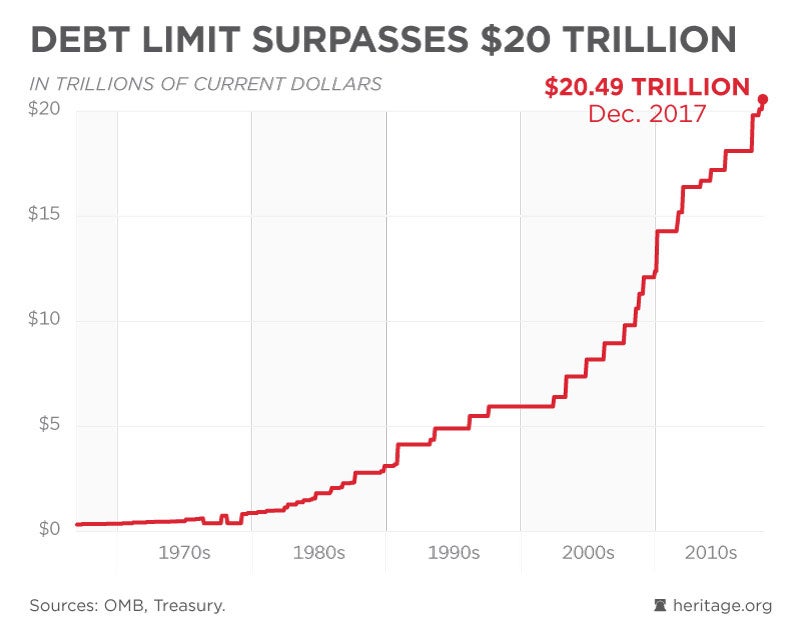
2. The debt reached $20 trillion.

The year 2017 marked the first time the national debt exceeded $20 trillion. The debt reached this level in September when President Donald Trump struck a deal with House Minority Leader Nancy Pelosi, D-Calif., and Senate Minority Leader Chuck Schumer, D-N.Y., to continue funding for domestic and defense programs, provide relief in light of Hurricane Harvey, and suspend the debt limit. Since then, the debt limit was reinstated at $20.4 trillion in early December.

3. Social Security spending reached $1 trillion.

This year marked the first time that Social Security spending on the Old-Age, Survivors, and Disability Insurance programs topped $1 trillion. Social Security is the single largest federal benefit program. It has held this rank since 1993, when it first surpassed spending on national defense. Without reforms, both Social Security programs are projected to reach insolvency by 2034.

4. Three continuing resolutions.

Federal law dictates that Congress must pass a budget to fund national defense and domestic programs that are categorized as discretionary spending, each year by Sept. 31. The congressional budget process specifies that Congress should provide this funding in the form of 12 individual spending bills so as to allow for proper deliberation of funding priorities. But Congress rarely, if ever, follows this process, which is also referred to as “regular order.”

Three months into fiscal year 2018, which began on Oct. 1, Congress has already passed three temporary continuing resolutions. The last continuing resolution was passed on Dec. 22 and sets up the next funding deadline on Jan. 19.

Continuing resolutions are a flawed way of funding the government—but when the alternative is a potentially $200-plus billion spending increase from a deal to breach budget caps that are currently in law, a continuing resolution at current funding levels is the lesser evil.

5. First Trump budget was proposed.

The president released his first official budget proposal in May 2017. The “America First” proposal would balance the budget within 10 years, prioritize national defense spending, and reduce spending on nondefense discretionary programs by more than $1.4 trillion over 10 years.

It would also implement policies to reduce the reach and weight of the federal government by eliminating wasteful and duplicative programs, and by rolling back harmful regulations that reduce individual freedom and hamstring the national economy. But Congress has not given the president’s proposals the serious consideration that they deserve.

This year, Congress broke several budget number records and kicked the can on funding for the federal government into 2018. This, despite the fact that America’s new president introduced a bold budget to reduce the size and scope of government—including many ideas embraced by Heritage Foundation policy experts.

 Read The Heritage Foundation’s “Blueprint for Balance.”

Federal spending is on an unsustainable upward trajectory, driving national debt to economically harmful levels. This comes with consequences that will be felt for generations in the form of lost opportunity and less prosperity.

Now that Congress and the president have achieved significant tax reform, they must work together in 2018 and beyond to realize fundamental budget reform. If they fail, the gains just realized on taxes could be too soon undone as out-of-control spending exerts pressure to raise taxes in the not-too-distant future.

As deficits are projected to reach $1 trillion annually before the end of this decade, Congress and the president must not delay to cut spending, right-size the federal government, and reform unsustainable entitlement programs. Succeeding at that is critical to restoring America to greatness.

Monday, January 01, 2018

The Liberal Mind Explained And Described : Can One Picture Do This?

This assumes that the porgresive socialist liberal democrat acutally have a brain this corruptible. Most progressives liberals demonstrate on a daily basis they have no connection to reality but operated on some kind of remote control saying the same thing over and over and over again.

Like the definition of insanity, 'saying the say thing over and over again but expect different results.' Democrats take a perverse pride in having a solid talking point to use every time they are challenged, even though it isn't relevant to the discussion and makes no sense, they continue to make their point with increased volume, making irrivlent noises they are convinced, believe beyond a doubt they are right. Discussion is over.

As the saying goes, trying to argue a point with an idiot, on-looks will not know who the idiot is. The picture of the liberal brain below can not adequately describe the disease that is liberalism and how it has effected  the DNA of the individual.  Liberalism is a cancer of which those that have it are doomed to live a life of despair and pestilence.

Like when Casey struck out that day in Mudville, all hope disappeared. And so it is with progressive liberal democrats. When Trump was elected against all odds, 93 to 1, the liberal mind lost any power for self control leaving the individual with only the most basic forms of identity, loathing and hate for Trump, Republicans and themselves.

Democrats Demonstrate Hoplessness : No Plans And No Ideas! Bankrupt!


democrats are hopelessly bankrupt of ideas and morallessly corrupted.
For democrats, stating idiocy is par for the course if it achieves the desired results. More money and power for them. The progressive socialist liberal demcocrat leadership knows that no matter how far into the cesspool of false promises and failed programs designed and implemented by democrats, OgbjmaCare, their voter base will always continue to vote for more of the same.

It's like the Lemmings headed for the cliff, no fence or trench or any other construction will stop their headlong charge to destruction.

So, just because there isn't any water doesn't mean there necessarily aren't any fish. The progressive socialists liberal democrats blindly attack in all direction hoping for a strike that will produce the desired effect showing their agenda is creditable and true.

And yet, what we see and hear from democrats is so obviously false in their claims in light of known facts by most in the trenches, that just with common knowledge, the democrat's agenda is seen contrary to what is fact.

Still, the progressive liberal democrats proceed blindly forward with their nonsense arm waving and screams of coming disasters, Nancy Pelosi as she proclaims the Trump agenda that will kill millions and devastate the country.

Obviously what is really at stake here is Trump is exposing the progressives socialist liberal democrats as purveyors of baseless, worthless issues of bad news coming even when they know the general public, especially the millions that voted for Trump any others that doubted, are enjoying the fruits of their vote last November.

Everything is better then it was just one year ago. That is, everything is better then was for the last 8 years of Barack and his ilk in the socialist liberal democrat collective that nearly drove the country into financial ruin and psychological despair.