Thursday, May 02, 2019

democrats Pelosi And Schumer Buying Votes : Infrastructure Spending A Scam


Photo
democrats are here to deceive. This is about buying votes and
Donald Trump knows it!
And the best way to fund this monster is to cut federal spending. 

And a good what to start the ball rolling is to having a 10% cut in all federal spending at every agency and every department, including the military.

By the way, what ever happened to the $852 billion that Barrrack spent on ''shovel ready jobs''? 

Remember the CEO of General Electric, Immelt, then the head of the jobs program had a good laugh with Barrrack when the entire system didn't work to creat jobs but the money was spent non the less. 

Barrrack laughed saying that didn't work out real well, other then most of his voters in the states that got the money for themselves, especially the unions that were going broke in those states, it worked great.

Trump, Democrats Agree to $2 Trillion Infrastructure Plan. How to Pay for It Will Come Later.
Fred Lucas / /

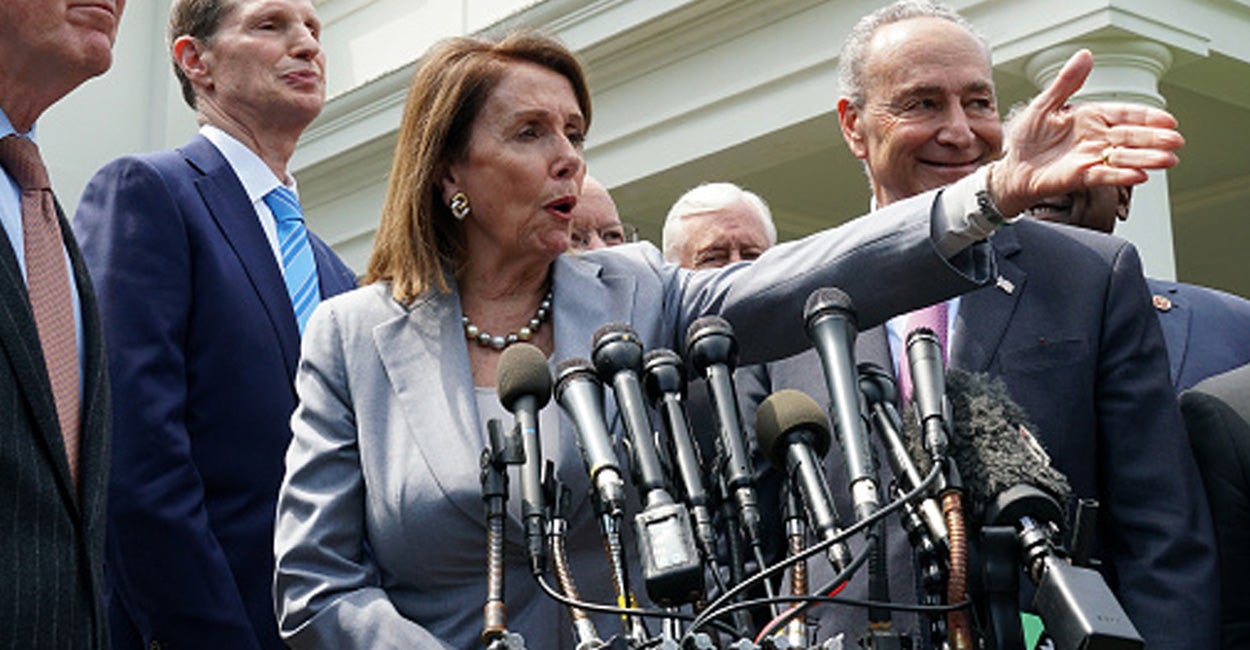
President Donald Trump and a delegation of congressional Democrats agreed Tuesday on “big and bold” infrastructure plans with an equally big price tag of $2 trillion over 10 years.

The discussion of how to pay for it was left for another day. Democratic leaders noted it would include expanding broadband internet access and work on the nation’s power grid, in addition to road construction.

Senate Minority Leader Charles Schumer, D-N.Y., said there was much “good will” from the meeting with the president, a marked departure from previous meetings where illegal immigration was discussed. “We agreed on a number. This is very, very good: $2 trillion for infrastructure,” Schumer told reporters after the meeting at the White House. “Originally, we started lower. Even the president was eager to push it up to $2 trillion.”

In three weeks, members of Congress will meet again with the president to discuss how they would pay for the big-ticket plans.

White House press secretary Sarah Huckabee Sanders, while not repeating the price tag cited by Democrats, noted bipartisan agreement in the meeting. “The United States has not come even close to properly investing in infrastructure for many years, foolishly prioritizing the interests of other countries over our own,” Sanders said in a statement.

“We have to invest in this country’s future and bring our infrastructure to a level better than it has ever been before. We will have another meeting in three weeks to discuss specific proposals and financing methods,” she added.

Five other Democratic senators and five other Democratic House members joined Schumer and House Speaker Nancy Pelosi, D-Calif., in the meeting with Trump and other administration officials.

Pelosi said, “We did come to one agreement, that the agreement would be big and bold.” “It’s about jobs, jobs, jobs. It’s about promoting commerce. It’s about clean air and clean water. It’s a quality-of-life issue, of cars not being on the road so much, and in every way it is a safety issue,” she said.

But the proposal’s huge price tag drew immediate fire from the fiscally conservative free-market advocacy group Americans for Prosperity, CNBC reported.

“If Congress wants to find money to modernize our roads and bridges, we encourage them to look to their own pockets. Americans have been filling them up for years,” said Brent Gardner, the group’s head of government affairs. “Instead of proposing a $2 trillion catch-all ‘infrastructure’ bill and asking hardworking Americans to fund it by paying more at the pump, Washington lawmakers should cut the red tape and stop wasting the tax dollars we give them.”

The New York Times's ''Gray Lady'' : Now Just A Whore for Liberal democrats

Photo
Enemy of individual freedom and prosperity?

The reason The New Times(NYT) hates Jews and Israel is for the same reason the NYT hate Donald Trump, they both have principles and they stand strong for those principles. 

Oh, and they are effectively bringing success and prosperity as well as individual freedom, independence to these countries, sure killers for the ideology of progressive socialist liberal democrats that demand obedience and submission.

Why Most Jews Aren’t Bothered by the Times’ Anti-Semitic Cartoon
Dennis Prager / /

Last week, The New York Times published a cartoon so anti-Semitic that Bret Stephens wrote in his Times column that it was “an image that, in another age, might have been published in the pages of Der Sturmer.” Der Sturmer was the Nazis’ major anti-Semitic newspaper.

A Times columnist charging the Times with publishing a Nazi-like cartoon is quite a moment in American publishing history.

For those who haven’t seen the cartoon, here is Stephens’ description:

''The Jew in the form of a dog. The small but wily Jew leading the dumb and trusting American. The hated Trump being Judaized with a skullcap. The nominal servant acting as the true master. The cartoon checked so many anti-Semitic boxes that the only thing missing was a dollar sign.''

The dog leading Trump had the face of Israeli Prime Minister Benjamin Netanyahu and was wearing a Star of David necklace. Trump was wearing a back yarmulke.

For those naifs and Israel-haters who dismiss such depictions as merely “anti-Zionist” or “anti-Israel” but not anti-Semitic, the yarmulke on Trump’s head should be the giveaway, as should the theme itself—the Jew leading the Gentile astray, one of the oldest anti-Semitic canards.

Of course, the cartoon is not just about Israel or Jews. It is about Trump, whom the left so hates. It depicts him as the stooge of both Russian President Vladimir Putin and Netanyahu.

There is no truth to either depiction, but if truth mattered to the left, there would be no left.

Truth is a liberal value, and it is a conservative value, but it is not a leftist value. Truth to the left is pravda. Pravda, the Russian word for “truth,” was also the name of the Soviet Communist Party newspaper.

So, the question is: Why would The New York Times, published in the city where more Jews live than any other city in the world outside of Israel, whose publisher is a Jew and whose editors are disproportionately Jewish, publish a Nazi-like anti-Semitic cartoon?

Here is Stephens’ answer:

''For some Times readers—or, as often, former readers—the answer is clear: The Times has a longstanding Jewish problem, dating back to World War II, when it mostly buried news about the Holocaust, and continuing into the present day in the form of intensely adversarial coverage of Israel. The criticism goes double when it comes to the editorial pages, whose overall approach toward the Jewish state tends to range, with some notable exceptions, from tut-tutting disappointment to thunderous condemnation.

For these readers, the cartoon would have come like the slip of the tongue that reveals the deeper institutional prejudice. What was long suspected is, at last, revealed.

Stephens continues:

''How have even the most blatant expressions of anti-Semitism become almost undetectable to editors who think it’s part of their job to stand up to bigotry?

The reason is the almost torrential criticism of Israel and the mainstreaming of anti-Zionism, including by this paper, which has become so common that people have been desensitized to its inherent bigotry. So long as anti-Semitic arguments or images are framed, however speciously, as commentary about Israel, there will be a tendency to view them as a form of political opinion, not ethnic prejudice. But as I noted in a Sunday Review essay in February, anti-Zionism is all but indistinguishable from anti-Semitism in practice and often in intent, however much progressives try to deny this.''

Exactly right. As I wrote in “Why the Jews? The Reason for Anti-Semitism” 40 years before Stephens wrote his column, there is no difference between anti-Zionism and anti-Semitism.

Of course, one can criticize Israel, just as one can criticize any country, but that is not anti-Zionism. Anti-Zionism is not criticism of Israel. It is a hatred of Israel—a hatred greater than that of any other country and a delegitimization of Zionism, the movement to reestablish the Jewish national home.

Imagine someone who argued that the establishment of the Italian state—Italy—was illegitimate and who hated Italy more than any other country in the world yet claimed that he was in no way anti-Italian, as he had Italian friends and loved Italian culture. No one would believe such an absurdity.

Why aren’t most American Jews troubled by the Times’ cartoon? Why were all American Jews horrified by the anti-Semitic shootings at the California synagogue this past weekend, while most barely had their feathers ruffled by the anti-Semitic cartoon in one of the most influential media in America?

The answer is most American Jews, while ethnically Jewish, are ethically leftist. And ethics trump ethnicity—as they should. For most American Jews, therefore, the Times is far more consonant with their ethical values than are Jewish values (if, by Jewish values, we are talking about the Torah and traditional Jewish religious/moral teachings).

So, then, when you combine hatred of the right-wing prime minister of Israel and reverence for the left-wing Times, even a Nazi-like cartoon—if it negatively depicts Netanyahu and Trump and is published in The New York Times—is no big deal.

COPYRIGHT 2019 CREATORS.COM

Rep. Rashida Tlaib Was Afraid After 9/11 : She Knew The Muslims Weren't done.

And she was correct, she should have been afraid as all  foreign and domestic terrorists individuals live in the Untied States that want to destory America be frightened. 

She was frightened that she might be caught up in the next attack by Muslims. And it is a fact that 98% plus of all attacks on the United States since 9/11 were carried out by Muslims. Who knew??!!

Rep. Tlaib is completely aware of this fact and it's obvious she agrees with the terrorists that attacked us as she is campaigning in support of the those that want us obedient and submissive or dead. 

But what is more important that all United States citizens were frightened then that the Islamic terrorist weren't through attacking our country, ready and willing to kill us all. We also know now the threat is still real. The radical Muslims are slaughtering Christians across the world by the thousands.

Muslim terrorists have told us on many occasion they either must drive us all to our collective knees or we all must die. There isn't anything in between submission or death.

Rep. Rashida Tlaib: I Was ‘Really Afraid of My Fellow Americans’ After 9/11
Molly Prince / /

Democratic Michigan Rep. Rashida Tlaib revealed in an interview she was “terrified” for herself and her family after the Sept. 11 terror attacks that left nearly 3,000 Americans dead.

“I was probably in my second year of law school when 9/11 happened and I was really terrified of what was going to happen to my husband, who was only a green card holder at the time,” Tlaib said during an interview with Makers, a media company founded to “accelerate the women’s movement.”

“I immediately called my brothers and told them to be very careful who you hang out with,” she continued. “Telling my sisters, ‘Just be real careful out there,’ and being really afraid of my fellow Americans.”

Watch the video : https://youtu.be/JOZ046bJM58

Tlaib, along with fellow Democratic Minnesota Rep. Ilhan Omar, became America’s first Muslim congresswomen when sworn into office in January. Their time in office has been embroiled in allegations of anti-Semitism and anti-American sentiments.

Tlaib came to the defense of Omar after the Minnesota congresswoman was accused of downplaying the 9/11 terror attacks that were perpetrated by radical Islamic terrorists.

The controversy kicked off after Omar delivered the keynote speech at a fundraiser for the Council on American-Islamic Relations on March 23. A video from the event was uncovered weeks later where Omar was shown urging Muslim Americans to “raise hell” and “make people uncomfortable.” Omar faced backlash after a part of the speech surfaced where she described the Sept. 11 attacks as merely an event where “some people did something.”

Tlaib consequently blamed the outrage over Omar’s statements on racism, claiming people “do this all the time to us, especially women of color. They do that. They take our words out of context because they’re afraid, because we speak truth.”

Tlaib has also received widespread criticism for her ties to anti-Israel and terror-affiliated activists. Pro-Hezbollah, anti-Israel activist Abbas Hamideh said he attended her swearing-in ceremony and the following private dinner, and Tlaib hosted in her congressional office Joe Catron, an avowed supporter of multiple Palestinian terrorist organizations such as the Popular Front for the Liberation of Palestine, Hezbollah, and Hamas.

She is also a member of multiple anti-Semitic social media groups, including the Facebook group “Palestinian American Congress,” where members frequently demonize Jews and Israel. The founder of the aforementioned Facebook group, Maher Abdel-qader, is a Palestinian activist and was a key fundraiser for Tlaib’s 2018 congressional campaign.

Like Omar, Tlaib has fundraised for CAIR, a notable pro-Palestinian organization with ties to Islamic terror groups. The U.S. Department of Justice listed CAIR as an unindicted co-conspirator in funding millions of dollars to the terrorist organization Hamas. Additionally, the United Arab Emirates named CAIR a terrorist organization along with al-Qaeda and the Islamic State in 2014.

“[9/11] really pushed me to be more involved and I got really curious and really angry,” Tlaib continued to Makers. “I think that combination got me in front of a number of issues in the city of Detroit.”

Content created by The Daily Caller News Foundation is available without charge to any eligible news publisher that can provide a large audience. For licensing opportunities for this original content, email licensing@dailycallernewsfoundation.org.

The Mainstream Media Bias : Don't Allow Others To Take Control of You.

Again, the New York Time, 'The Gary Lady' is no longer the ''paper of record''. It is a mere shadow of it's former self. Now a mouth piece for progressive socialist liberals. The ''Gray Lady'' is nothing more then a whore for the socialist left! Don't buy into the nonsense that is found in the delusional media like the New York Times or the Washington Post, let alone the worst of cable news like CNN or PMSNBC. Always rely on yourself to make the important decisions that will ultimately effect you directly. Make sure you have correct information obtained from legitimate news organizations that base their news on historical facts. Most people know what is right and what is wrong in the news as they are living it. It is so important to be well informed because it can mean voting for your own self destruction. Nothing worse the finding out when it's too late you were lied to and you were to busy or lazy to get and understand the facts about important issues. Be actively involved instead of being reactive to situation you have no control of.

Wednesday, May 01, 2019

Immigration Reform : Change The System Now!

This seems so clears to many that are not totally invested in finding people to vote for them and believe just because they can't speak, read or write English doesn't mean they don't have the right to vote democrat. 

Even worse, in many cases these new immigrates are not proficient in Spanish and many can't read or write in Spanish.

But pay no attention to the 1.4 immigrants that are arriving as we speak over the next 18 months and millions more if the wall is not built in following years. And know each immigrant will cost America $76,000 each to cloth, feed, educate and provide healthcare. But how about all of the relatives that will follow? Approximately 47 or 60 others per immigrant that will have a legal right to come to America.

4 Keys to the Immigration Reform We Need
Genevieve Wood / /

Immigration is one of the fundamental building blocks that help make America the unique nation that it is.

But the debate over border security and immigration has become toxic because politicians have put politics before principles. And reasonable Americans find themselves trapped between zealots on both sides.

For over two centuries, the United States has welcomed millions of people from every corner of the globe. And today, we lawfully admit over 1 million people every year. That is more than any other country in the world.

The debate is not about whether we should allow immigration—it’s about how we do so in a way that protects American sovereignty, respects the rule of law, and is beneficial to all Americans.

So what does a thoughtful agenda for American immigration reform look like?

Watch the Video : https://youtu.be/tZHuZUQ0atA

Here are four guiding principles:

1. We must respect the consent of the governed—that is, the will of the people.


Individuals who are not citizens do not have a right to American citizenship without the consent of the American people. That consent is expressed through the laws of the United States.

Through those laws, we the people invite individuals from other countries, under certain conditions, to join us as residents and fellow citizens.

2. We cannot compromise national security and public safety.

Every nation has the right, recognized by both international and domestic law, to secure its borders and ports of entry and control what and who is coming into its country.

A disorganized and chaotic immigration system encourages people to go around the law and is a clear invitation to those who wish to take advantage of our openness to harm the nation.

Secure borders, especially in a time of terrorist threat, are crucial to American national security.

3. Becoming a citizen means becoming an American. We must preserve patriotic assimilation.


The founding principles of this nation imply that an individual of any ethnic heritage or racial background can become an American. That’s why we have always welcomed immigrants seeking the promises and opportunities of the American dream.

Patriotic assimilation is the bond that allows America to be a nation of immigrants. Without it, we cease to be a country with a distinct character, becoming instead a hodgepodge of different groups.

If we are to be a united nation, living up to our motto of e pluribus unum—out of many, one—we all must understand and embrace a common language, history, and civic culture.

And that not only benefits America, but also those immigrants and their families who aspire to prosper here.

4. Our lawmakers must respect the rule of law, and immigration is no exception.

Failure to enforce our immigration laws is unfair to those who obey the law and follow the rules to enter the country legally.

Those who enter and remain in the country illegally should not be rewarded with legal status or other benefits. When politicians condone such behavior they only encourage further illegal conduct.

Based on these principles, immigration reform should include transitioning to a merit-based system. We should end practices like chain migration, birthright citizenship, the visa lottery, arbitrary per-country immigration caps, and any form of amnesty for those here illegally.

We must close loopholes that prevent enforcement of our laws and have overwhelmed immigration courts, allowing illegitimate asylum claimants and other lawbreakers to remain in the U.S. indefinitely.

And we must take on these issues one by one. A comprehensive “deal” subjects the fate of policies with universal appeal to the fate of the most controversial topics. The key is to begin by working on the solutions on which most Americans agree.

We must and can address this issue in a manner that is fair, responsible, humane, and prudent. This is too important an issue to not get right and too important an issue to be driven by partisan agendas.

Let’s stay focused on what is best for the welfare of all Americans, both those of today and those of the future.

God Understands Humanity : He Has a Design To Make Things Work(Humor)

If there is one thing that will be demanded by a fisherman or a golfer, it bragging rights.

God Know How Things Work

One spring day a man decided to call in sick to work so he could go fishing. After making the call, then lying to his wife telling her that he would be working late, he headed out to the lake, retrieved his boat from storage and set out
to try his luck.

Meanwhile up in heaven, God and an angel were watching these events unfold and the angel said,
"Are you going to let him get away with that?" to which God replied,
"Of course not. He'll pay the consequences"


So the man reached his favorite fishing spot and immediately pulled in the largest bass he had ever seen.
Excited, he cast again and hauled in another huge fish. This went on all day long. The man couldn't believe
his good fortune and had the time of his life catching record size fish.

Up in heaven the angel was stunned. He looked at God and said "I thought you said he would pay the consequences."

God smiled and said,

"Who's he gonna tell about it?"

What Did Trump Actually Do For Success? : What Made America Better?

Trump became a hero for the needs of the people. Those of us living and working down in the trenches of real life instinctively know our government is not working us and has been corrupted by people that want to do us all harm.

What makes Donald Trump different from the progressive socialist liberal democrats and many spineless Republicans now in power or even from the dim past, they, the people actually believe Trump! The people actually trust him to represent them and the country as founded. 

The people believe his is one of us!! Oh No! Who knew?

Photo

The Inside Story of Trump’s First 2 Years in Washington

Jake Sherman, senior writer at Politico and co-author of Politico Playbook, is the co-author with Anna Palmer of the new book “The Hill to Die On: The Battle for Congress and the Future of Trump’s America.” The Daily Signal spoke to Sherman about the book and the ways President Donald Trump has transformed Washington. Our full interview is below along with a lightly edited transcript. 

Podcast : https://soundcloud.com/dailysignal

Rob Bluey: Congratulations on the success of your book. It’s already a New York Times best-seller. You and Anna have done a remarkable job of chronicling the first two years of Trump’s presidency and the battles that have taken place in Congress. Tell us why you decided to write it.


Sherman: We were approached to write a book about Congress at the beginning of 2017. Anna and I had thought about this many times over the years. We thought about whether we can write an interesting book about Congress. We’ve always been convinced that Congress has the best story in the world. And we think it’s the best story in politics even more than the White House.


When Trump got elected, we had a sense that it would be very interesting because it was clear he was going to not conduct himself as a typical and ordinary president. That’s been clear now, it was not clear to the extent to which he would be able to do that in 2017. We figured how the deals got done, or didn’t get done, would be a fascinating story.

We started, basically, with Election Day 2016, ended with the shutdown, which was not planned, obviously, at the beginning of 2019. And we told the story, not as a Trump story solely, but as a story about Paul Ryan, Kevin McCarthy, Mitch McConnell, Nancy Pelosi, and the Freedom Caucus. The trials and travails and ups and down contained within those characters. We took a different tact, which was to not focus maniacally on Trump, as a lot of books have done, but through Congress’ eyes.


Virginia Allen: Based on your reporting, what are some of the biggest changes that you’ve observed in Washington during Trump’s presidency?


Sherman: A few things. It’s a good question. A few things. No. 1, I think—and this is not a major theme of the book, but it came up time and time again—the role of cable news in the Trump administration in shaping both his view and the policies that he supports.


We have several instances throughout the book, where Sean Hannity of Fox News was acting as an informal adviser, both to the president and to Republicans on Capitol Hill. That’s basically unheard of. I’m not saying it’s criminal or anything, it’s just not typical for another administration in other time. That’s probably one of the big ways things have changed.


Also, as it’s been reported a million times, the extent to which the president is talking to just many, many, many people all the time is fascinating. Imagine if you’re CEO of a company, and you’re calling up dozens of people before you make a decision throughout the company, and that’s kind of what the president does. I think those two are the major changes.


One thing that I’ve observed second hand since the book has been released is mostly in places like New York and L.A. and on the coast, people always ask me, “Are Republicans going to be happy when he’s gone?”


The thing that I and your listeners might sympathize with this, the thing that I don’t think a lot of people understand is that there’s a whole country besides the coast, where the president is exceedingly popular, and that’s reflected on Capitol Hill, or at least was between 2016 and 2018.


This is not a Trump fan book. It’s not a Trump hate book. And there’s been a lot of those two things. …


Bluey: We certainly appreciate that reporting that you’ve done. Robert Novak is one of the people who I looked to when I was getting my start in reporting. I love the fact that he was able to bring that insight much the same way that you and Anna do in Playbook every day, and you do as well in this book.


One of the things that you write is that during those first two years of the Trump administration, Congress gained power, but you say shrank in its willingness to exercise it. How do you see that changing now that Democrats control the House? Is there a greater appreciation for Congress’ Article 1 responsibility today?


Sherman: I would say a few things. What we meant by that is Congress gained in power because there was a president who didn’t really understand Washington, or government really. … It’s not me saying that, that people like Mitch McConnell told me he basically didn’t know how Washington worked in any way, shape, or form—which, by the way, allowed McConnell to reshape the judiciary.


But when we say shrank in its willingness to use it, at times, it has the opportunity to, for example, shore up Robert Mueller’s investigation. It did not do that. But going forward, I think it’s quite clear that the legislative branch and the oversight responsibilities and powers that Congress has are going to be used more than ever. We see that.


We see now that the Democrats are considering using penalties, fiscal penalties, monetary penalties for people who don’t testify to their liking or fork over documents. I think we’re about to see a major sea change in Congress’ power and how it used it. I would say the president vastly, as my reporting would show, vastly underestimated how bad a Democratic House would be for him.


He told us in an interview in the Oval Office, Republicans were too nitpicky when it came to controlling the house. They had too many changes to legislation, he didn’t appreciate that. Now, he has a Democratic council who he thought that he would be able to work with based on his relationship with Chuck Schumer and Nancy Pelosi, and he finds itself under a barrage of very serious investigation. I don’t think he anticipated that.


Allen: You write about the government shutdown in the book, how that happened and the fallout. In both cases, President Trump squared off against Speaker Nancy Pelosi and Sen. Chuck Schumer. What did you learn about their relationship? Is there any chance of them working together on legislation?


Sherman: I would say I learned a lot. I was eager to learn a lot because it’s a very unique relationship. Let me start backward, kind of.


In 2017, the president, as many of your listeners will remember, cut a deal with Chuck Schumer and Nancy Pelosi to keep the government open in place of cutting a deal with Paul Ryan and Mitch McConnell, who had a different view. We make the case in the book that that deal that he cut to keep the government open for three months—lift the debt ceiling for three months and provide disaster relief for places like Texas—led to a lot of the border squabbling that we saw over the years.


I think the president appreciates the flare he gets, the coverage he gets for cutting deals with Democrats, No. 1. No. 2, he has a reverence for Nancy Pelosi that he does not have or did not have for Paul Ryan, I would say for sure.


He doesn’t understand why Democrats stick together so much better than Republicans. He said as much to us on the record that Democrats stink with their policies, they’re bad politicians, but they stick together and Republicans do not.


He likes Pelosi. He actually had planned to convince the Freedom Caucus to support Nancy Pelosi for speaker if she fell short with Republicans, which is a stunning statement and a lot of your listeners will appreciate that. That’s unheard of. The Republicans have spent hundreds of millions of dollars trying to prevent Nancy Pelosi from taking back the majority.


… I was optimistic that he would cut deals with Democrats, I had been in 2016. I don’t believe right now there’s the climate to do so for many reasons. Chief among them that the president is exercising his power, and we’ll see how much power he’s able to exercise in preventing Democrats from talking to members of his administration and getting documents that they deem pertinent. That is going to be a huge battle both legislatively, politically, and legally—I would imagine.


I would imagine that the cost of Nancy Pelosi trying to cut deals with Donald Trump goes up exponentially if he’s unable and unwilling to participate in oversight in his administration.


Bluey: I want to follow up on that in my next question. Much of the tension with Democrats over those two years has centered on immigration and border security. We’re now hearing that Jared Kushner, who’s referenced throughout the book, is working on a plan.


How much influence does Kushner have with the president? Do you see any potential for him to repeat the success that they had with criminal justice reform on an issue like immigration?


Sherman: Rob, as you know, Republicans have been for criminal justice reform for many years. You’ll remember Paul Ryan in late 2016 had a deal basically cut with Barack Obama to do something similar in criminal justice reform.


A lot of Republicans and Democrats believe Jared’s prowess when it came to criminal justice reform was a little bit overstated. Because he convinced Republicans to do something that Republicans were already willing to do. That’s No. 1.


No. 2, Jared obviously has huge influence with the president. He’s the son in law, trusted adviser, from what we could see. Jared also doesn’t really, in my reporting, and according to Republicans who were in the room with him, does not really grasp the issues on immigration reform as he would need to to cut a deal. That’s not my assessment. Republicans who he’s worked with, that’s their assessment.


He, in the beginning of the shutdown, said, “I’ll be able to quickly solve this.” And then proceeded to convince the president to negotiate with Democrats and, of course, he negotiated with Democrats and he had to declare a national emergency. He’s not as savvy as maybe he thinks he is when it comes to immigration reform.


I would say, there are two sides to this issue. We make the argument in the book that Democrats were completely disingenuous when it came to the border walls and opposed it because it was Donald Trump’s border wall.


Democrats had approved the border wall many times before in different forms, but Donald Trump made the border wall about himself. Democrats were then incentivized to oppose it. That’s kind of how it went at the beginning of this year.


I’m skeptical—I’m a skeptic because I’m a reporter—that reform will happen. I think the two sides, frankly, just have way different views on immigration reform. Jared Kushner is not going to bridge those gaps, which are basically defining gaps between the two parties at this point. I’m skeptical that he’ll be able to do that.


Allen: You had the opportunity to speak with the president. What insight did you gain from talking to President Trump directly? Given his hostility toward the press, what is he like one on one?


Sherman: I think his hostility toward the press is obviously disappointing to members of the press, but he’s still … We see he just spoke to The Washington Post, Bob Costa for a story about oversight of his administration. He speaks to reporters all the time.


Obviously, he sees it politically expedient or politically benefiting him to stoke a war with the press. But that’s his choice. It’s disappointing because we live in a country where freedom of the press is of such huge importance and such a defining characteristic of our country.


It’s a little bit befuddling to me why he does that. But that’s that. I thought he was a lot more engaged in the kind of rough and tumble of D.C. politics than I expected.


I don’t mean that I didn’t expect him to be engaged in politics. He’s obviously the president because he’s a pretty good politician. But I didn’t anticipate that he would understand the characters and the palace intrigue as he did with the tension between Jim Jordan and Kevin McCarthy or Nancy Pelosi’s inability or her quest to become speaker again. All of those things were really interesting to me, how he was very tuned into those dynamics.


He’s a friendly guy who I would say enjoys, basically, my assessment was he would be talking to the press all the time if it were up to him. Obviously, he has gripes with the covers, but so does every president. Nothing to do with that. Those are my general impressions of dealing with him.

Bluey: Now, Jake, from our own reporting at The Daily Signal, we know what a whirlwind it has been since President Trump was elected in November 2016. As you reveal in the book, there’s been quite a bit of tension between the conservative House Freedom Caucus and Republicans in leadership and Congress.


Based on your reporting, who has a bigger influence on President Trump today? Is it someone like a congressman, Mark Meadows or Jim Jordan, who lead that Freedom Caucus? Or the Republican leadership of Kevin McCarthy and Mitch McConnell?


Sherman: We have an interesting dynamic now because in the last Congress, Meadows and Jordan were oiled to Paul Ryan and disagreed with him on a lot. In the end, the president sided with Meadows and Jordan, which led to a government shutdown over immigration.


Now, he has a lot of trust in Kevin McCarthy. Kevin McCarthy is a close ally of him. As are Mark Meadows and Jim Jordan. I think the relationship between Meadows and the president is no longer as important as it once was because the Republicans are out of the majority.


But for those two years, between 2016 and 2018, the House Freedom Caucus, the 20 or so members, depending on the issue of the House Freedom Caucus, were the most important people in Washington and perhaps some of the most important people in the country because they had veto power over any legislative issue.


But today, I would argue that McCarthy and McConnell have a little bit more sway than Jordan and Meadows. Jordan and Meadows do play an important role though. They are the president’s defenders on the judiciary and oversight committee, and that’s incredibly important.


Allen: You’ve mentioned the influence that Sean Hannity wields with President Trump. Who else like him is influencing the president behind the scenes?


Sherman: Well, there’s nobody who’s quite like Hannity, based on my reporting. We have a couple of instances in the book, and I’ll mention two of them. He was on a conference call on health care reform, Sean Hannity was with Paul Ryan and Mark Meadows. We’ve never seen something like that before, or at least not in my experience. That’s incredibly odd.


I know, because I was there, that Sean Hannity was talking to members of the Freedom Caucus during the government shutdown, and they were swapping ideas, swapping strategy. That’s very, very unusual.


I can’t remember, and forgive me if I’m wrong, but I can’t remember Rachel Maddow on the phone with President Obama during health care reform or anything like that. Perhaps it was happening and we missed it.


But I would say there’s no parallel to Sean Hannity. Maybe Lou Dobbs, who the president obviously appreciates his views on immigration and other things of that nature. But Sean Hannity is really a singular figure for President Trump.


Bluey: Finally, you’ve been reporting on Capitol Hill now for 10 years, and you’re also an NBC and MSNBC contributor. You’ve earned a lot of respect and credibility for the work and reporting that you’ve done. What is your advice to those who are getting their start in journalism today?


Sherman: I work hard because there’s nothing really that replaces hard work. I would say a few things. I would say, and I’m guilty of this, too, don’t spend too much time on Twitter because it’s a pretty poisonous place. But I would also say that there’s really no plus if you’re an even reporter for a news outlet, there’s no plus in picking sides. There really isn’t.


My entire career has been covering House Republicans. The media’s viewed as liberal. My job is not to choose sides. My job is to adequately and accurately reflect what the views are of the people I’m covering and inject skepticism where necessary.


But there’s no reason to be a partisan in a nonpartisan environment. It’s just not worth it. If you can’t get both sides to talk to you, you don’t have much going in this business.


I would say, be there all the time. I spend 12 to 14 hours a day in the Capitol, and that’s how people get to know you, and people get to trust you when you’re talking to them, when you don’t need something. That would be my top-line advice.


Bluey: That is really great advice. I think that it’s something that is certainly a lost art as reporters today look for easier ways to go about getting stories, but there’s nothing better than showing up, being there in person, talking to people directly, face to face.


Sherman: Thanks, Rob. Appreciate it.
College Students Demand Equality of Outcomes : What Is a College Education For?

Photo
Progressive socialist liberal democrats demand 
''transformation'' of civil society.
It's called a failure in education to teach history so the mistakes of the past are not mistakes of the present.

But in reality, the lessons learned from our schools for not teaching history is not just a failure of academia, it is an agenda, a strategy an ideology at work.

What's happening in our educational system is not by accident, but a designed approach to bring the ''transformation'' promised by Barrrack and his cohorts in the socialist liberal collective where a centralized authority must make the difficult decisions for everyone that will result in total inclusion and equality in our country. 

No one will benefit from society more then anyone else, no one except leadership which needs special dispensation to rule. What could be more fair then that? If you are in doubt, talk to most any college individual, they will tell you how important it is to be fair and equal.

Then ask this person why they are in higher education? To get a better job then someone else who isn't in school? Is that fair!!!!????

I’m a College Student. Here’s Why I Oppose Socialism.
Courtney Joyner /

In the 2016 presidential primaries, 2.1 million people under age 30 voted for democratic socialist Bernie Sanders. But do young Americans really know what it means to live under socialism?

Cambodia, like other countries in the past and present, offers clear evidence of the outcomes of socialist policies such as the Green New Deal championed today by many liberals in the U.S.

Bopha Sayavong, a family friend of this reporter, lived in Cambodia in the 1970s when it was under both socialist and communist control. She survived the government’s work camps and was able to come to America in 1981.

“People that refer to themselves as the millennial [generation], they have no clue what socialism is,” Sayavong, now a pharmacist in Illinois, told me. “I lived in both socialism and communism, and then I lived in the world of the U.S. One thing I can tell you is there is no place like the U.S.”

 A Teen Refugee’s Flight to Freedom From Communist Cambodia

However, the enthusiasm with which millennials advocate socialist policies suggests an ignorance about history, markets, and government. This is in part due to the failures of the education system.

Liberal arts courses in the United States are ripe with the opportunity to teach the proper context needed to understand the consequences of socialism and communism. However, the education system’s failure to connect the dots leaves students with the impression that socialism is a venture yet to be tested.

“People think it’s so wonderful, it’s so fantastic, but that’s not true,” Sayavong said. “It’s just like a painting—it looks fantastic. But when you live in it, then you know it. It brings me pain to even think that our children go that far [consider socialism].”


American college students have the luxury of viewing the world from an ivory tower, combating injustice through thought experiments.

Students approach the world’s problems as if this were a game in which there are no consequences, and every variable is easily known and controlled. They say: “If we could remove markets, there would be no poverty, and if the government made the decisions, there would be no oppression.”

This critique of higher education has been made many times over many years by conservative academics. William F. Buckley Jr. shocked the academic world with his 1951 book “God and Man at Yale” and its scathing critique of the liberal bias at Yale University. Still, to this day, higher education doesn’t provide a more rounded view of the world.

History classes fail to teach that notions such as socialism already have failed the test of time, and the outcomes have birthed nothing but pain and suffering.

For example, 2 million people died between 1975 and 1979 at the hands of the communist Khmer Rouge regime. Headed by Pol Pot, that regime put Cambodians, including Sayavong’s family, in work camps.  That’s almost as many dead as the number of young Americans who voted in 2016 for Sanders.

Other such experiments include the Soviet Union, Vietnam, Cuba, and now Venezuela, all of which produced some of the most severe human rights violations known to man.

Economics classes in college fail to teach students that capitalism provided ubiquitous products such as the iPhone that almost every student takes for granted. These classes also fail to teach that competition and innovation provide affordable goods and services, as opposed to oppressing the poor.

Lauren Chen, a conservative YouTube blogger based in Canada, stated the issue clearly April 14 on “The Ben Shapiro Sunday Special” when she said: “Millennials don’t know who people like Pol Pot, or Stalin, or Mao are, which is kind of to me what being a millennial is all about—all of the enthusiasm with none of the knowledge.”

Just as college campuses don’t solve the world’s problems, Capitol Hill doesn’t solve the country’s problems. A few congressmen can’t pull a few levers and push a few buttons to secure equality. The swipe of a pen at the bottom of a nonbinding resolution “creating” the Green New Deal doesn’t eradicate poverty.

“I do believe in equality,” Sayavong told me. “I want … no rich, no poor, all even; but as a human being, think about it: If the government tells you what to do, how to eat, how to breathe, how could that be equal? They are above you.”

Firsthand experience with socialism and communism has been around to offset academia’s utopian visions for a long time.

Perhaps because unlike baby boomers and Generation X they don’t have wars to fight, millennials and Generation Z have the privilege to disengage from history.

Ol' Joe Likes The Ladies : What's Wrong with Touchy / Feely?


Some are saying it's the ''big stick'' approach(from behind). Hey, enough already. It's no big deal about his ''hand on'' policy when campaigning around the country. This is just nonsense. Don't look at this as it is not representative of ol' Joe. It's not fair that he is seen as a groper and a sniffer, when it's just that he likes to get close to his constituents.  

Jeeese! It's just politics people. Come on, he's a lover. What's wrong with that?